
Transitioning from Fortune 500 corporate consulting to building a high-growth remote recruitment agency requires moving from high-level advisory frameworks to direct execution. In the modern remote work environment, connecting global companies with specialized Latin American (LatAm) talent enables organizations to scale operations predictably without sacrificing execution standards.
On an episode of the Scale You Podcast, hosted by Le-an Lai Lacaba—co-founder of an Executive Assistant Agency, 2xYou—sat down with Brian O’Connor, founder of Talent HQ and a former Deloitte management consultant. Brian shared his journey from advising enterprise boardrooms as a fractional CMO to launching a recruitment agency that has placed over 130 LatAm professionals across software-as-a-service (SaaS), e-commerce, and agency sectors in the US and Europe.
From Deloitte Consulting to Accidental Agency Owner
Brian began his career at Deloitte, specializing in corporate strategy and growth frameworks for Fortune 500 companies. Looking to share these strategic insights with a broader audience, he began posting simplified growth frameworks online, expanding a digital audience to over 90,000 followers on LinkedIn and Twitter.
This online visibility led small-and-medium-sized business (SMB) founders to seek his advisory services. While developing comprehensive marketing strategies for these companies, Brian faced a recurring operational roadblock:
“My clients would say, ‘Great marketing plan, Brian, but who's going to run it? Because it's not you.' We needed to build teams. So I went into Latin America and started grabbing teams to plug into those businesses… That became its own thing.” — Brian O’Connor
Choosing to focus entirely on building a scalable enterprise over advisory consulting, Brian launched Talent HQ, specializing in placing LatAm project managers, customer support leads, customer success specialists, and growth marketers.
The Operational Difference: 0-to-1 vs. 10-to-100 Growth
Having advised enterprise corporations, Brian noted the distinct operational differences between early-stage business building (0-to-1) and scaling established enterprises (10-to-100):
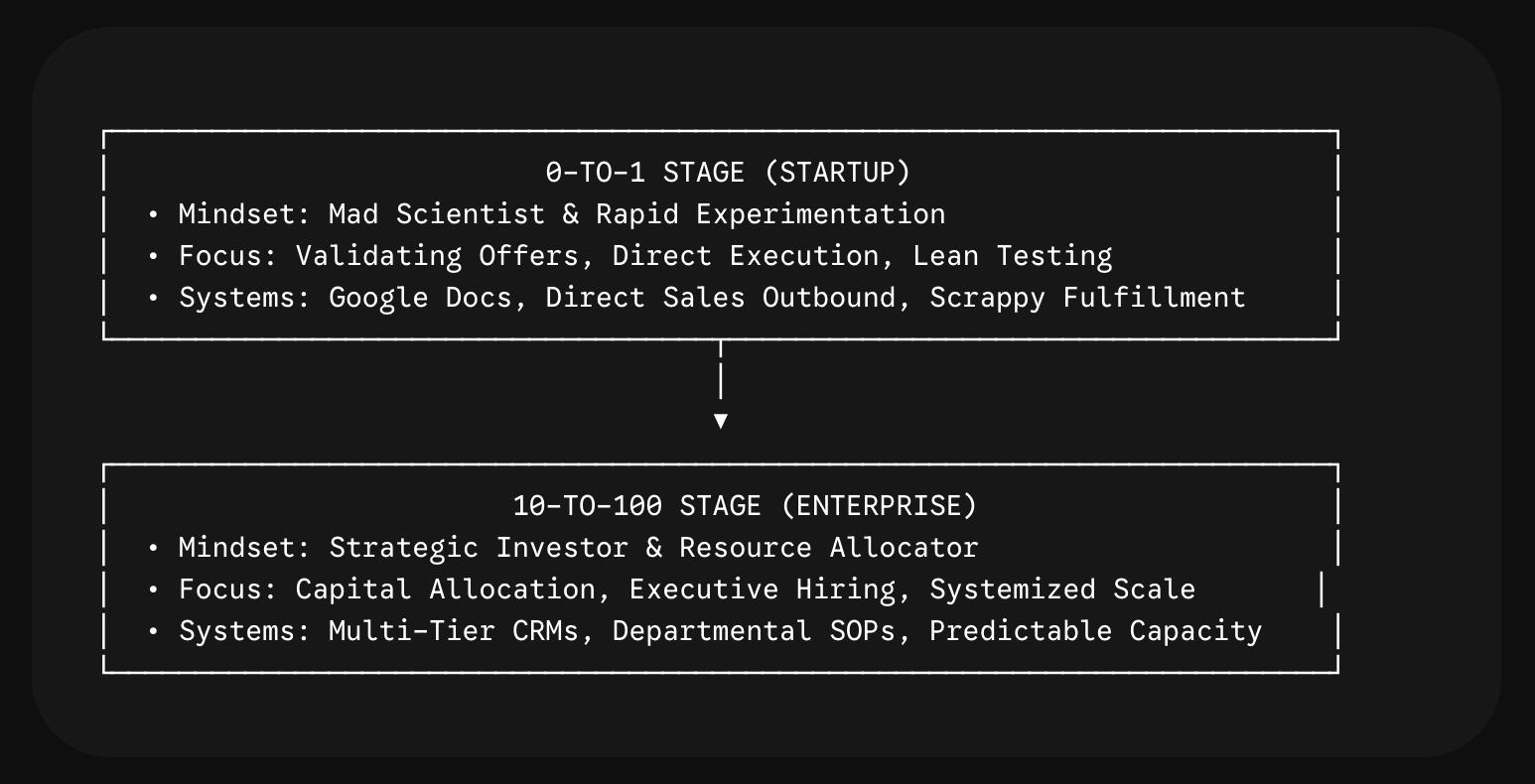
To validate Talent HQ without over-engineering early infrastructure, Brian partnered with an experienced operator to sell their first $20,000 in revenue directly from a Google Doc, white-labeling backend operations before investing in complex software stacks.
Common Scaling Pitfalls: Premature Capacity Hiring
Reflecting on the growth seasons of his agency, Brian highlighted a critical mistake common among early-stage founders: premature capacity hiring.
Following a rapid increase in monthly recurring revenue (MRR), Brian hired multiple internal teams simultaneously—including AI developers, content specialists, outbound representatives, and an operations manager.
Key Takeaways from Scaling Seasons:
-
Avoid Predictive Hiring Too Early: Hiring ahead of predictable, long-term recurring revenue creates unnecessary administrative overhead and drains executive focus.
-
Focus Bottlenecks: Spreading executive attention thin across multiple unproven internal initiatives creates operational friction. Systems must be validated individually before adding headcount.
-
Stress-Testing Growth Engines: Rapid lead spikes reveal backend operational bottlenecks. Sales conversion pathways must be optimized to handle lead volume effectively.
Integrating AI Interviewers into Remote Recruitment
To manage high applicant volumes—averaging roughly 3,000 applicants per open position—Talent HQ integrated custom AI interviewers into its initial candidate screening workflows.
Rather than replacing human recruiters, the AI screening layer filters applicant pools rapidly, allowing human managers to focus exclusively on qualified candidates:
-
Transparent Candidate Expectations: Candidates receive introductory video communications explaining the use of AI interviewers, framing the technology as a modern, efficient assessment step.
-
Expanding Sourcing Reach: AI tools allow recruitment engines to screen 100% of applicant pools rather than limiting evaluations to top-tier resume submissions.
-
Role Adaptation: While customer support and sales roles evolve alongside AI automation, human involvement remains critical for high-touch, complex communication tasks.
“Humans do what they're good at, AIs do what they're good at… We haven't seen disruption in the sense of replacing roles, but changing roles.” — Brian O’Connor
Watch the full episode here.
Want to have a Remote Executive Assistant in your business? Your journey starts here!