
Building a specialized, highly scalable agency requires narrowing your focus, creating standardized processes, and leveraging modern technology. In the e-learning space, moving from generalized software administration to a high-converting, niche service model is key to sustainable growth.
On an episode of the Scale You Podcast, hosted by Le-an Lai Lacaba—co-founder of an Executive Assistant Agency, 2xYou—sat down with Christopher Dundy, CEO of Flagship LMS. Christopher shared his journey from serving 12 years in the US Marine Corps and teaching across the globe to building an agency that deploys fully branded, open-source learning management systems (LMS) in just one week.
From the Marine Corps and International Classrooms to EdTech
Christopher’s professional path began far from digital education. Raised in Juneau, Alaska, he enlisted in the US Marine Corps, serving seven years enlisted and five years as an officer. After leaving the military, he spent over 14 years living, working, and teaching in Korea, Japan, the Philippines, Saudi Arabia, and Lebanon.
His transition into educational technology occurred in 2007 while teaching at a university in Korea:
“I was exposed to this thing I’d never heard of before called a learning management system… As a teacher in the classroom, I suddenly realized I could record a lecture or analogy once, and that asset was available to every class 24 hours a day. I never had to say the same thing again.” — Christopher
Recognizing the potential of online learning platforms, Christopher shifted his career to LMS administration, serving in higher education, corporate settings, and the Peace Corps.
The Turning Point: Transitioning from Employee to Founder
After years of managing platforms for public institutions and private companies, Christopher took a role as a client success manager for a commercial LMS provider. Constantly dealing with bug-ridden software and frustrated users inspired him to launch his own enterprise.
However, moving from a technical specialist to a business founder presented a steep learning curve. Christopher notes that early-stage entrepreneurship demands resilience—a willingness to face daily setbacks, adapt, and refine operations.
His first major lesson came from his initial enterprise client, Planet Fitness. Running the firm with just one part-time developer and an underpowered server taught Christopher the critical importance of robust infrastructure, database management, and scalable server architecture.
The Two Operational Breakthroughs that Scaled Flagship LMS
Scaling Flagship LMS into a firm supporting major organizations—including the Maryland State Teachers Association, Pennsylvania State Teachers Association, and Johns Hopkins University—relied on two specific operational shifts:
1. Niching Down to a Single Platform
Early on, the agency took on work across multiple systems (Canvas, Blackboard, D2L Brightspace, Cornerstone, and Moodle). This approach created operational complexity and erratic developer workloads.
Inspired by The $100 Startup, Christopher made the decision to specialize exclusively in Moodle, the open-source platform his team knew best. While turning away non-Moodle clients was difficult initially, it allowed the agency to streamline tool stacks, refine internal skills, and establish market dominance in full-service Moodle hosting and administration.
2. Standardizing Delivery with the “Checklist Manifesto”
To eliminate human error, ensure consistency, and maintain high service quality, Flagship LMS built a systemized operational model based on Atul Gawande’s The Checklist Manifesto.
Every process within Flagship LMS—from platform deployment to course development—follows strict, step-by-step checklists:
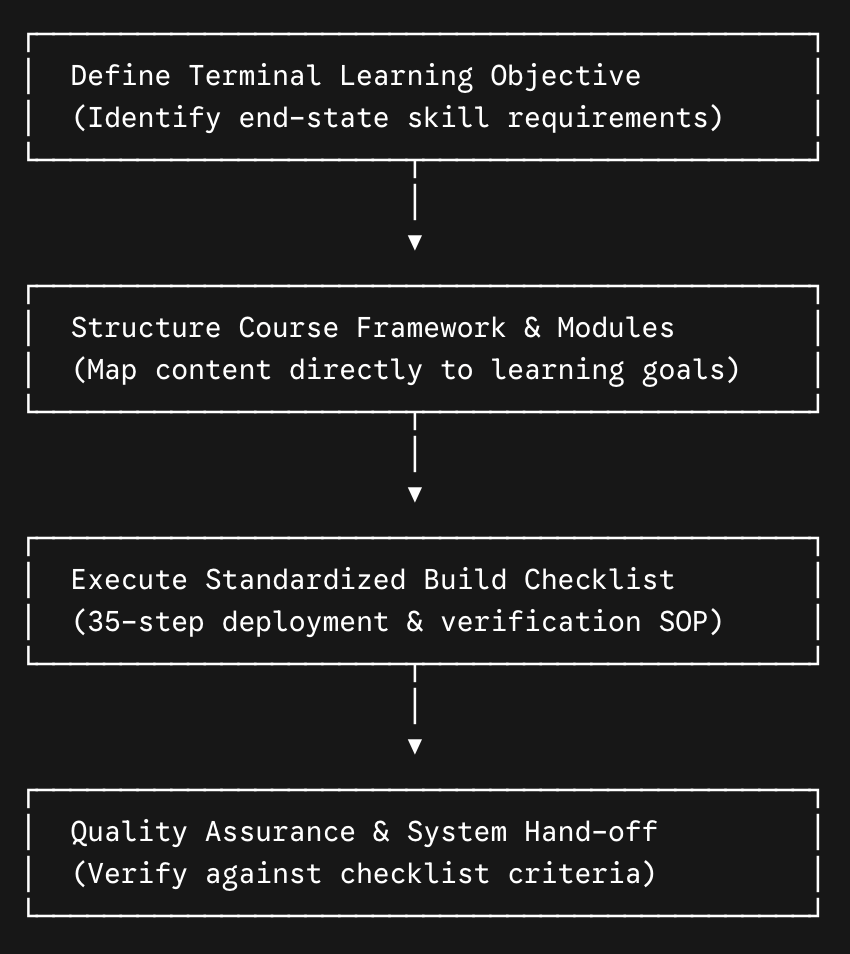
By standardizing every workflow into rigid SOPs, the agency delivers reliable, repeatable results regardless of team member transitions or project scope.
The Future of EdTech: Integrating Agentic AI into LMS Architectures
With deep experience tracking e-learning trends since 2007, Christopher views Agentic AI as the next major evolution in online education.
Unlike standard Large Language Models (LLMs) that primarily generate text, Agentic AI executes complex tasks autonomously within software environments:
-
Sidecar Integrations: Connecting autonomous AI agents directly to core LMS databases to handle administrative tasks.
-
Automated Course Skeleton Generation: Rapidly structuring course frameworks and learning pathways based on raw subject-matter expert inputs.
-
Predictive Learning Analytics: Analyzing user engagement, click paths, and completion times in real time to recommend tailored interventions or supplementary content.
“Agentic AI executes commands and actually builds something for you… There are limitlessly possibility to what you can do when you have something that is essentially a 24-hour worker, running a thousand times faster than the average human.” — Christopher
Watch the full episode here.
Want to have a Remote Executive Assistant in your business? Your journey starts here!