
Thriving in high-stakes operational environments requires an unmatched level of personal accountability, adaptability, and operational precision. In live production and technology, execution leaves zero margin for public error.
On an episode of the Scale You Podcast, hosted by Le-an Lai Lacaba—co-founder of an Executive Assistant Agency, 2xYou—sat down with Anca Trifan, an award-winning global AI speaker, audiovisual (AV) production executive, agency owner, and host of the Events Demystified podcast. Anca shared her journey from immigrating to the US with a single ticket to founding Tree-Fan Events Productions, leading AI integration in event tech, and applying a competitive bodybuilding mindset to high-performance business operations.
From Radio Host in Romania to US AV Production Leader
Anca’s passion for audiovisual technology began during high school and college in Romania, where she worked as a radio host. Beyond being in front of the microphone, she was drawn to the technical backend—troubleshooting signal paths, mastering audio gear, and managing production setups.
When local cultural norms offered no path for a woman pursuing technical production, Anca bootstrapped her way to the United States at age 21.
“I got on a plane, moved to the US, and really worked my way up from the ground up… I went to school for audiovisual as a sound engineer, video producer, and lighting designer. I worked many high-stakes shows in LA with celebrities, entertainers, and fashion designers.” — Anca Trifan
Her early career was defined by relentless 18-hour workdays, loading in major fashion shows and convention-scale events. However, after collapsing on a convention floor in Las Vegas from total exhaustion during a three-day continuous setup, Anca recognized the need to shift from sheer grind to sustainable, systemized operations.
Overcoming Burnout: The Bodybuilding Framework for Business Performance
To recover from burnout while maintaining a high-capacity career, Anca adopted competitive bodybuilding as an operational framework rather than a simple side hobby.
Core Principles Applied to Business Leadership:
-
Extreme Personal Accountability: Bodybuilding offers no shortcuts or hidden efforts; public results directly reflect private discipline.
-
Delayed Gratification: Long-term goals—whether fitness milestones or multi-year business expansions—require consistent, unglamorous execution before yielding visible returns.
-
Energy Management Over Raw Time: Treating physical and mental conditioning as energy-generation mechanisms to sustain complex executive decision-making.
Through her performance framework, #FIT4EVENTS™, Anca translates these physical and mental conditioning strategies to help corporate executives and event leaders manage pressure without reaching depletion.
Blending High-Touch Human Experiences with AI Automation
The trillion-dollar global event industry—spanning healthcare, tech, finance, and government—is historically legacy-heavy and operationally brutal. Event production involves compressed timelines, multiple vendor orchestrations, constant decision loads, and zero tolerance for failure.
Rather than viewing Artificial Intelligence as a gimmick or a complete replacement for human connection, Anca positions AI as a core operational engine.
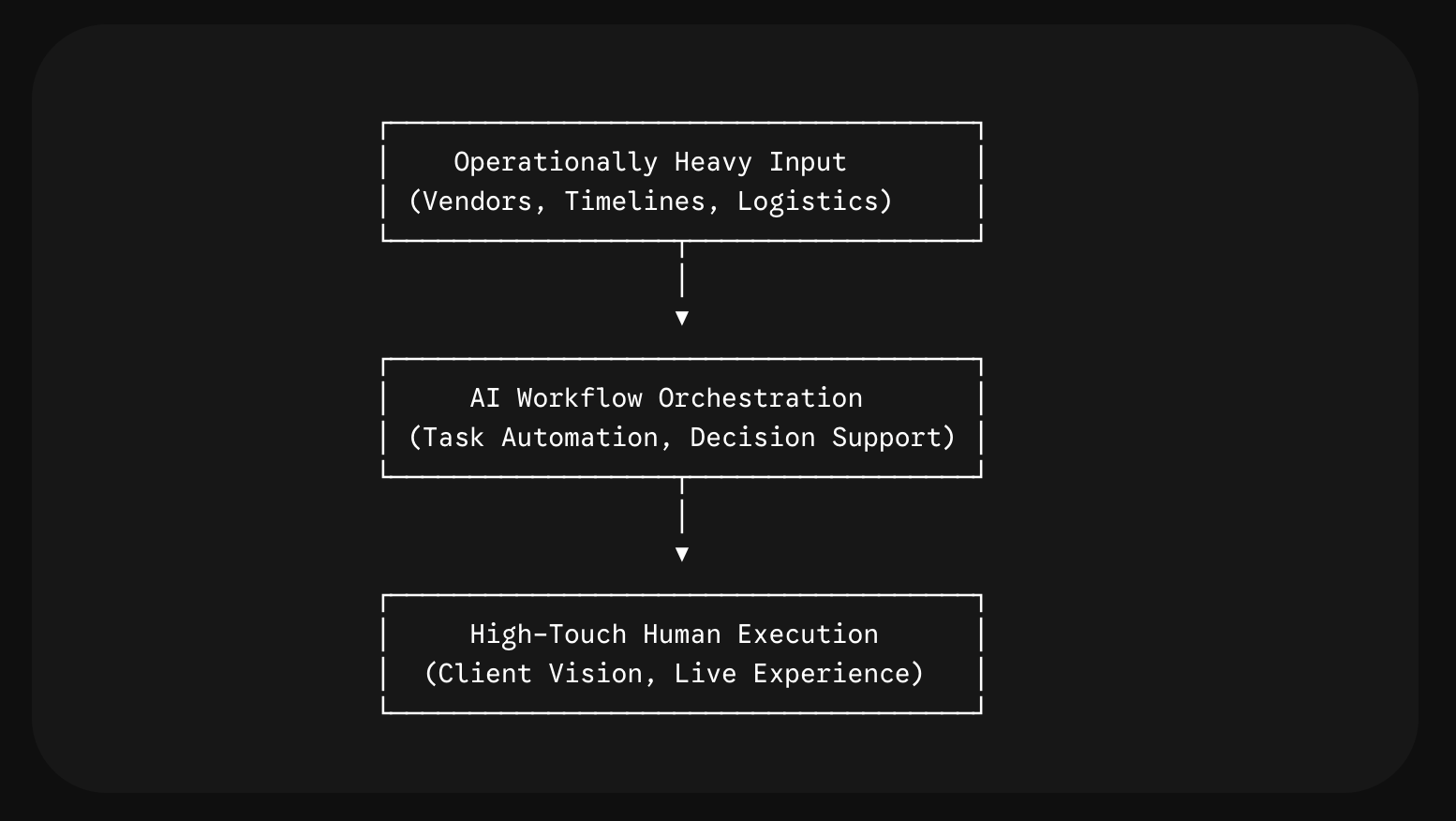
Key Applications of AI in Event Production:
-
Workflow & Task Orchestration: Automating repetitive vendor communications, logistics tracking, and administrative tasks.
-
Real-Time Decision Support: Using data-driven tools to handle live troubleshooting and contingency planning under tight timelines.
-
Elevating Human Impact: Offloading low-level operational weight so producers can focus on creative vision, client relationships, and live attendee engagement.
“I didn't move into AI because it was trendy. I moved into AI because I needed support… When I saw what AI and automation could do for workflow design, task orchestration, and decision support, I jumped all in.” — Anca Trifan
The Power of Discipline over Fleeting Motivation
Reflecting on two decades of growth, Anca emphasizes that long-term career evolution requires self-discipline and constant goal reassessment rather than relying purely on external motivation.
-
Reassessing Milestones: Periodically evaluating whether past goals still align with current growth, ensuring you don't pursue paths that no longer serve your vision.
-
Keeping Promises to Yourself: Honoring personal commitments—whether daily health routines, study, or operational standards—with the same level of respect given to client appointments.
-
Leading with Adaptability: Staying grounded in operational fundamentals while actively mastering emerging technologies to lead industry transformation.
Watch the full episode here.
Want to have a Remote Executive Assistant in your business? Your journey starts here!